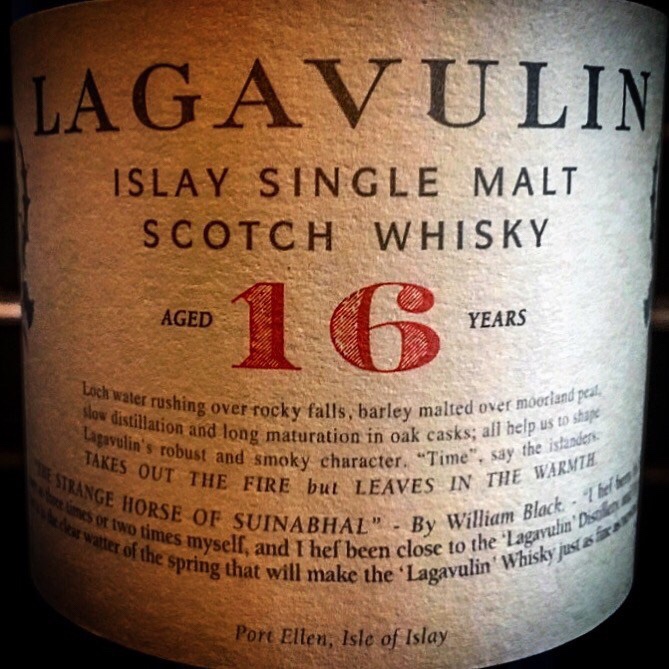

Lagavulin and Islay
Neill reviews the classic 16 year old single malt from Lagavulin Distillery in Islay.
In my first review, I had a look at the Chivas Regal 12-year-old blended Scotch but if truth be told, my heart belongs to the single malts and in particular, to the whiskies of Islay. I enjoy many different styles of dram but there is something so magical about that pungent Islay peat smoke.

Islay is one of five Scotch whisky ‘regions‘ as officially recognised by the Scotch Whisky Association. The other four are Speyside, Campbeltown, the Highlands and the Lowlands. In recent years there has been a growing feeling that island malts such as Talisker, Jura and Highland Park should be considered a separate region (something I happen to agree with) but at present, they are considered to be Highland malts.
In the past, whisky produced in the same region would likely have shared certain characteristics – just as the whisky of Islay is known for its distinctive smoky flavour. In most regions, a shared style is less noticeable today, though smoke remains a common thread running through the eight distilleries of Islay. Even Bruichladdich and Bunnahabhain, the unpeated malts, produce limited heavily peated versions.
Arguably one of the most renowned distillers of this famously peaty whisky, is Lagavulin. The distillery was founded in 1816, although the bay was home to 10 illicit stills dating back to at least 1742.
The Lagavulin malt has earned a reputation for quality and has a devoted fanbase that stretches around the world. I must admit to being something of a fan myself and although my collection and tastes permanently evolve, there will almost always be a bottle of Lagavulin waiting, ready to pour, in my home.
Lagavulin 16 Year Old Review
You can’t discuss Lagavulin without mentioning the classic 16-year-old malt, which comes bottled at 43% and retails for around £45.

At 43%, it’s safe to assume that the whisky has been chill-filtered. This is a process that involves lowering the temperature of the liquid until the oils and fatty acids congeal, allowing them to be sieved out when passed through a filter. I’ve never quite understood this, as these elements must surely contribute to the flavour and mouthfeel of the dram. Though, it must be said, Lagavulin doesn’t really struggle in either department. Such filtering is done for cosmetic reasons – whisky can turn cloudy in low temperatures and that leads some consumers to think there’s something wrong with their purchase. Chill filtering stops that from happening.
There’s also, very probably, been some artificial colouring added. This is also done for cosmetic reasons – a wee alteration to achieve consistency of appearance from batch to batch. It also plays into the widely held but incorrect view that darker whisky must be better whisky.
Smell: On the nose, there’s a generous hit of peat smoke – as you’d expect. There’s also plenty of vanilla with some fruit jam and oaky spices – black pepper and a definite hint of the sea.
Taste: Caramels and vanilla. Those jammy fruits again with a big wave of smoke and brine. Tingly oaky spice and a long, smoky finish.
Thoughts: Lagavulin is more expensive than the average entry-level single malt but at 16 years, it’s also a good bit older than most. The distillery produces an oily spirit so even at 43% and, presumably, chill-filtered, it delivers a robust, weighty mouthful every time. I’ve heard some say the quality has fallen over the years but I must admit, that doesn’t really match with my own experiences. I don’t drink Lagavulin 16 as much as I used to, but whenever it crosses my path I still find it to be of a quality that’s above many of its competitors.


Leave a Reply