
WHISKY REVIEWS, NEWS, HISTORY & FOLKLORE
A remote location?
Bunnahabhain is the most northerly distillery on the isle of Islay and therefore not what you could easily describe as accessible. Nowadays, the distillery is reached by traversing an 8 mile long stretch of single track road but when it was first established in 1881, there was no such passage. The only way to get there, other than cross-country, was by boat.
This notion places the distillery in rather an isolated position and you could be forgiven for imagining the life of a distillery worker as being akin to that of a lighthouse keeper on some rocky isle in the middle of the churning ocean. In truth, however, there are records that paint rather a different picture.

Around the distillery was a cluster of houses, built to accomodate the workers and it seems like there was quite the community spirit in the old days. Excerpts from the Oban Times of Saturday 21st January 1888 describe a packed end of year celebration…
“Notes from Islay – The employees of the Highland Distilleries Company at Bunnahabhain held their annual ball on Friday the 6th in one of the spacious granaries at the distilery, which was tastefully decorated with evergreens for the occasion. There was a concert and treat to the children in the neighbourhood being given during the earlier part of the evening. After a plentiful supply of tea and fruit, songs and recitations were given by several friends present, after which Mr Ferguson, Caol Ila, kindly entertained the children with his magic lantern displaying a number of beautiful views, among others a splendid view of Balmoral Castle, and views of different parts of Edinburgh and Glasgow, and a number of comic scenes, which gave great amusement to the children. Dancing was then commenced about half-past nine, when upwards of thirty couples were present. Excellent music was supplied by Mr MacLever, Bowmore, and Mr Nixon, Lossit, Mr R W Haine acting as M.C. with great ability. A long and varied programme was then gone through, dancing being kept up with great spirit until the early hour in the moring. During the intervals, while refreshments were being served, Mr A Campbell entertained the company with a number of comic songs in character. Selections of music on the bagpipes were also given by Messrs Brown and Campbell, two local pipers of no mean ability. After a vote of thanks and three ringing cheers had been given to the Committee of Management, and for Mr Haine for the excellent manner in which he had performed the duties of M.C., and also for Mr Grant, manager, all joined hands and after singing Auld Lang Syne, the company broke up, all being highly delighted with the evening’s entertainment.”
The Bunnahabhain of old doesn’t sound like such an isolated, lonely place, after all.
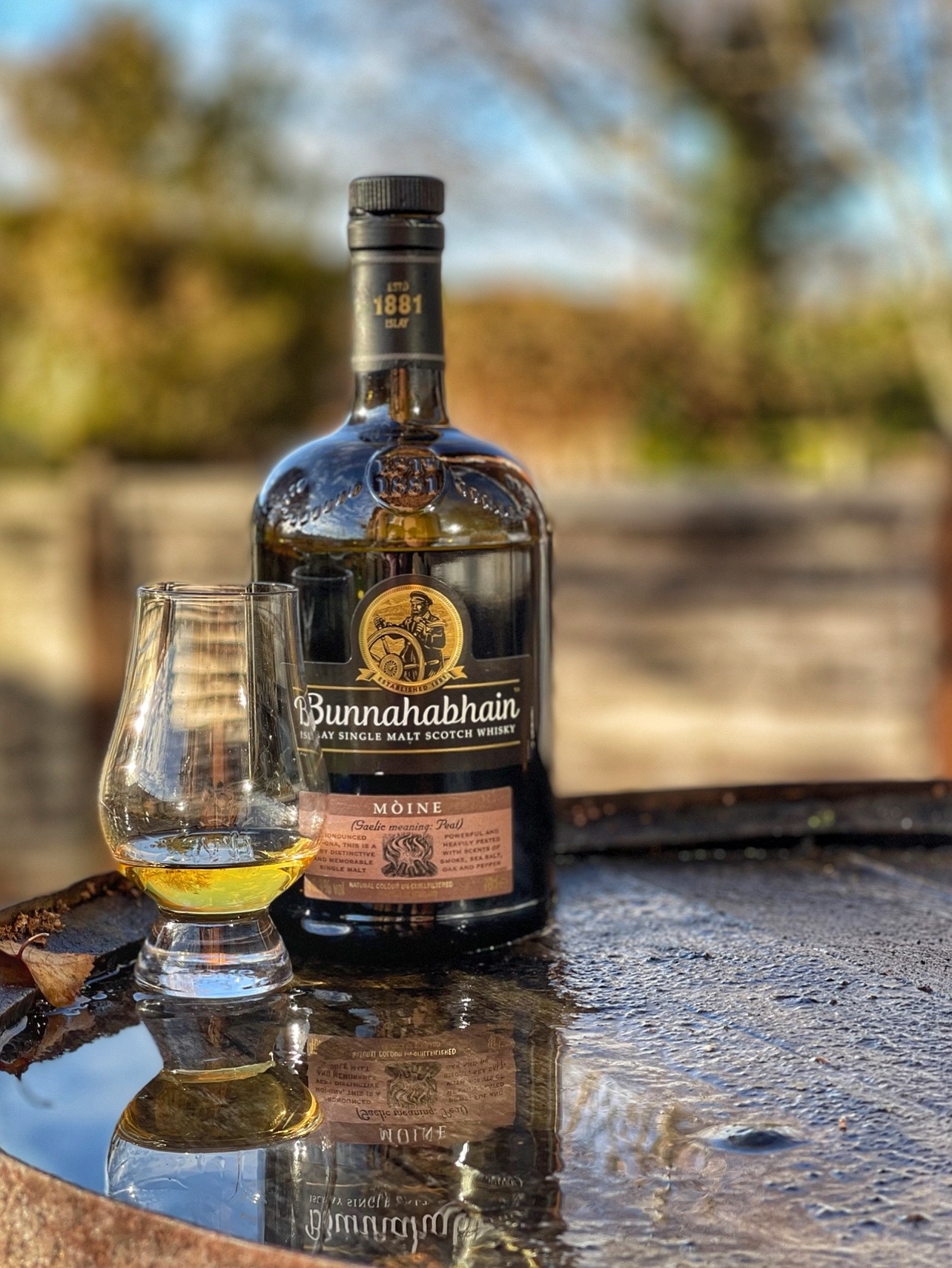
Bunnahabhain, like Bruichladdich (founded the same year), is famed for producing largely unpeated spirit, something which is unusual for Islay. This is perhaps, an indication of the primary purpose of the whisky, throughout most of its life. Like so many, Bunnahabhain was used to make spirit for Blended Scotch, most famously as an ingredient in the Black Bottle recipe. It was, in many ways, a slave to the demands of the blender. That said, experiments with peated malt have become increasingly common in recent years with the Mòine series winning over many fans.

Mòine, is Gaelic for peat.
A dedication to the traditional Celtic language of Islay is something commonly found in Bunnahabhain bottlings. Even the name, Bunnahabhain, is an aglicisation of Bon na h’abhainn, meaning foot of the river. I find it reassuring that the distillery has carried on this association with Gaelic, despite being under international ownership for a number of years. I accept that Scotch whisky is a global product with global appeal but that doesn’t mean it should shake off its roots to please the wider audience. I think it’s nice to see this honouring of the culture that spawned the product in the first place.
The Whisky

Mòine is an affordable take on the peated spirit of Bunnahabhain. As with all core bottlings, it comes in at 46.3% ABV.
Smell: Very evocative of Islay. Seashells, windswept beaches and damp peat fires! Pungent, medicinal smoke with TCP and Germolene but there’s also some honey and a nice maltiness to it that comes across a bit like digestive biscuits. A little bit of liquorice in the background as well. A splash of water brought out some lemon and a sort of, ozone-like aerosol spray can, note.
Taste: Salty and briney. Loads of sea salt. Salted caramel. Honey. A nice pepperiness comes in around the mid-palate and the smoke follows, developing towards the back and leaving dry, ashy smoke on the finish. Water intensified the pepper but the malt and salt seemed better integrated.
Thoughts: It’s quite a typical example of a young Islay malt. There’s lots of coastal atmosphere in the glass that conjures up memories of standing on the verandah at Bunnahabhain, feeling the sea-spray-laden wind lash my face. It really smells – and tastes – like Islay in a glass. Perhaps it’s not the most complex, since the smoke and coastal vibes dominate but there’s enough from the honeyed malt to keep it just about balanced and while there may not be an abundance of subtle layers, the flavours are bold and the higher ABV delivers good intensity and a satisfying mouthfeel.
Price: I picked this bottle up from Amazon for £32. It’s an excellent option to bear in mind should you find youself looking for a dose of Islay peat on a tight budget.
For more on Bunnahabhain visit here
WhiskyReviews.net is a free service and always will be. However, if you would like to support the author you can do so by subscribing for just £1 per month. Alternatively, you can make a one-off donation of your choice. Thank you for your support.
________


Leave a Reply