
The Glengyle Story
Glengyle distillery was originally founded by William Mitchell in 1872. At that time, Campbeltown was a thriving hub of distilling activity, known to many as the whisky capital of the world. The ‘wee toon’ as it is sometimes called, has been home to more than 30 distilleries over the years but by 1934, only two remained.
Prior to 1823, Campbeltown had been home to its fair share of illicit stills, with at least 21 known to be in operation around the town in 1795. The local authorities were quite happy to turn a blind eye to this activity and the foundation of a large scale maltings in the town only made the supply of raw ingredients more readily available.
The town benefited from a local coal mine and a railway link to the central belt, as well as one of the finest natural harbours in Scotland. So when the Excise Act of 1823 made it cheaper to distill legally, the blue touch paper was well and truly lit. With the required infrastructure already in place, nine distilleries appeared within the first two years. By 1837, there were twenty eight of them.
A turning of the tide…
When William Mitchell founded his Glengyle distillery in 1872, he could have had little notion of the difficulties that would later confront the whisky industry and in particular, the distillers of Campbeltown. The early 1900s saw confidence in the industry hit an all-time low thanks to the infamous ‘Pattison Crash‘, leaving dozens of businesses out of pocket. Then came the War, with fuel and barley shortages across the country, before Prohibition in the US robbed distillers of their primary export markets.
Unique to Campbeltown were an additional set of problems. The town’s distillers had come to rely on cheap coal that came by rail from the local mine. When it ran dry in 1923, they were faced with significant cost increases just to remain in production. The loss of the coal mine also had a knock on effect on the rail network. Unable to survive on local commuters and the occasional tourist, the railway closed in 1930, sounding the final death knell for the once proud whisky city.
Glengyle itself closed in 1925 and by 1934, only Springbank and Glen Scotia were still in operation and thus it would remain for more than 75 years until Mr Hedley Wright, chairman of J&A Mitchell, and great-great nephew of Glengyle founder William, decided that the time had come to breathe new life into the long lost distillery.
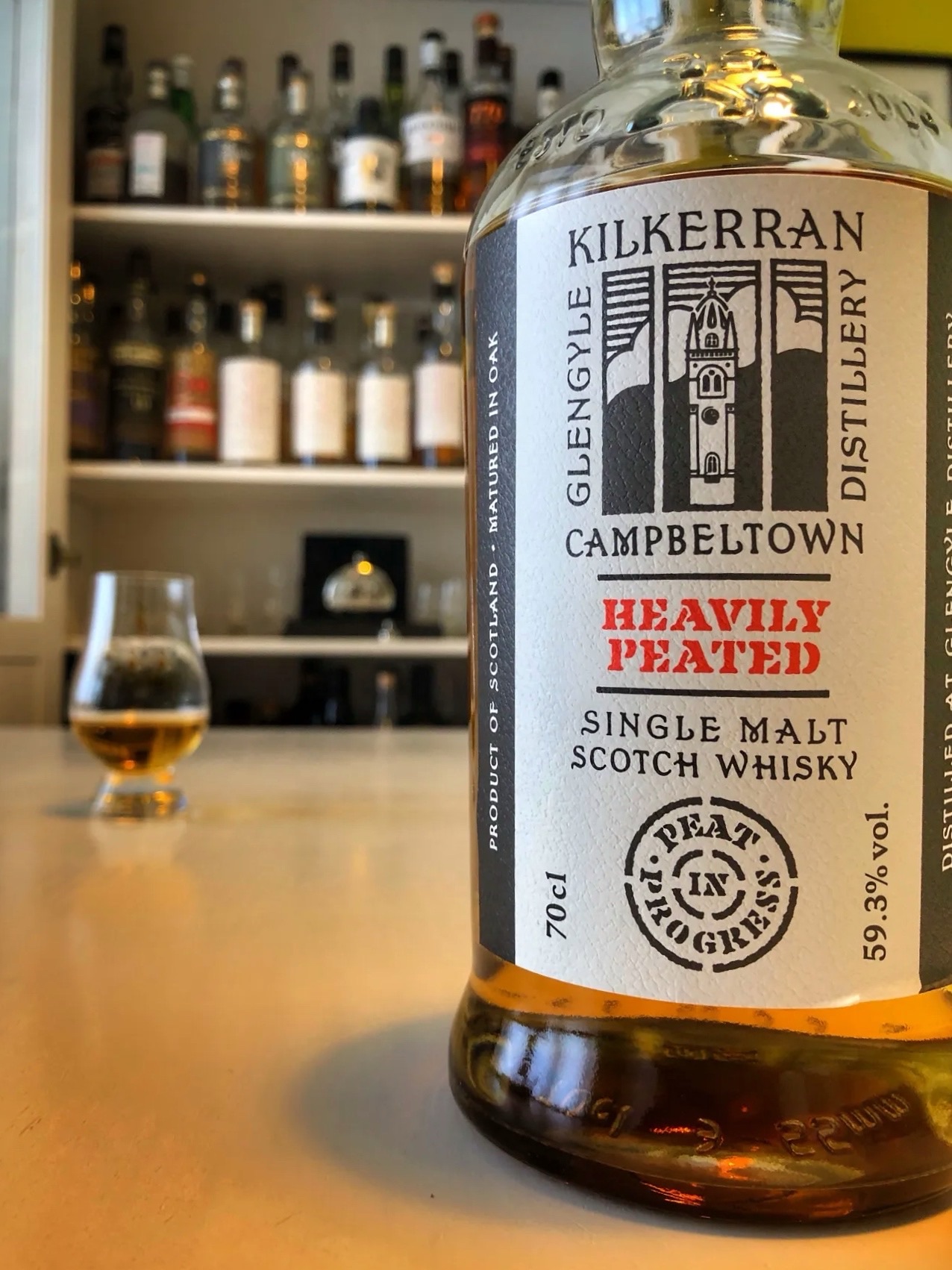
The site was purchased in 2000 and, after the completion of extensive rebuilding work, production of the new Campbeltown malt began in 2004. Branded Kilkerran, due to a rights issue over the Glengyle name, the whisky first began to appear as limited edition ‘Work in Progress‘ bottlings that gave a glimpse into the liquid’s development. 2016 then heralded the arrival of the first permanent 12 year old which was soon joined by an 8 year old Cask Strength version. That in turn was followed by the announcement of a new heavily peated variant.
The Whisky

The Kilkerran ‘Peat in Progress’ single malt is bottled at a whopping 59.3% and retails at the remarkably low price of £38.50.
Smell: Youthful. There’s a definite new make vibe, there’s also vanilla, apple, lemon, pineapple, some banana, cream and liquorice to go along with the smoke and ash.
Taste: Malty biscuits and vanilla with caramel and butterscotch. There’s also sea salt and brine with chilli powder, liquorice and thick smoke.
Thoughts: This is an exceptionally well-priced cask strength whisky. A work in progress yes, but a tasty one all the same.
This is one of the most exciting new releases of 2019. Despite its obvious youth, there’s real quality on show which, of course, makes one wonder what standards future releases might be able to achieve with some increased maturity and a taming of the spirit’s young fire. The peat-in-progress series could be one worth watching very closely in the years ahead.
Click here for more on Kilkerran.
__________
Leave a Reply