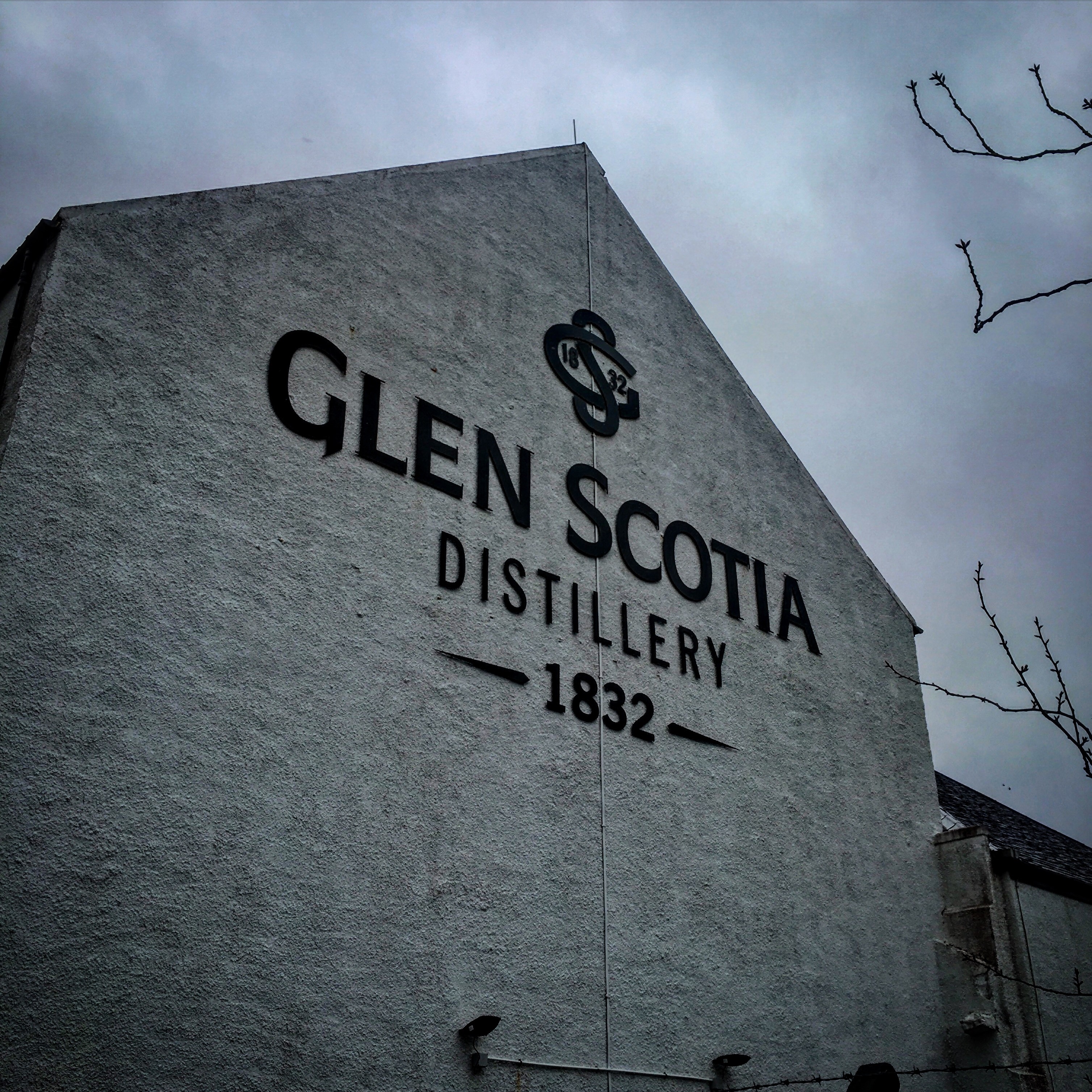

Glen Scotia of Campbeltown
A Scot on Scotch reviews a peated Glen Scotia (Cask 164) Distillery Exclusive, Campbeltown Single Malt.
It would be fair to say that Glen Scotia hasn’t always been the most popular of single malts but things are changing for this Campbeltown distillery. It was founded in 1832 and production has been on and off, ever since. Scotia changed hands in 2014 and the new owners have invested significantly in both distillery and brand.
I recently paid a visit to Campbeltown with the main intention of visiting Springbank but it would have been a crying shame to come all that way and miss out on Glen Scotia. It was a little tricky to organise a visit and took a few emails back and forth but this is a very traditional distillery, for whom public tours are very new. Despite their inexperience, however, the staff would prove the most welcoming of hosts.

Upon our arrival, we were warmly greeted by Callum, an 18 year Springbank veteran who had recently made the transition to Scotia. Here was an excellent ambassador, not just for Glen Scotia, but for Campbeltown and its whiskies as well.
We set off on a tour that covered each area of production, from milling and mashing to fermentation, distillation and maturation. The distillery is attractive if a little grimy (all the best ones are) and we were fortunate to spend some time chatting to Hector, the still-man, about his work. It’s not every tour you get the chance to chat with the people on the front line and it was a pleasure to run into Hector in the pub the following day and talk some more. Like our host Callum, he clearly took pride in his work at Glen Scotia.


After the tour, we enjoyed a tasting in one of the onsite warehouses. This gave us the opportunity to taste four drams drawn straight from the cask. We tasted unpeated, medium peated and heavily peated malts, before finishing with a 1989 vintage. Glen Scotia is a whisky that has sometimes underwhelmed me in the past but these four drams convinced me that it was perhaps down to bottling choices made by previous owners, rather than the quality of the spirit itself. At cask strength, it is a robust, engaging dram.


Back at the shop, we were taken through the core range of Double Cask, 15-Year-Old and Victoriana bottlings. Each is bottled at 46% and natural colour, with no chill-filtration. This in itself is a sure sign that things are heading in the right direction. Any of the three drams would have been more than welcome in my home collection but I opted instead, to purchase something a little different. I went for a peated malt from a single cask, one of just 410 bottles.
The Whisky
The whisky was distilled on the 22nd April 2002 and bottled on the 28th July 2011 at 45% abv.

Tasting notes: On the nose: seaweed and brine, malt and vanilla. There’s grassy smoke, charcoal, ash and barbecues. On the palate, more malt, salt and smoke. Touches of vanilla, honey, lemon juice, brine and wood smoke. Wee touch of liquorice at the end.
Thoughts: 45% is an unusual strength to bottle at but it made the dram very drinkable. Crucially, despite the lower strength, it hasn’t been chill-filtered. Or coloured which makes you feel you’re getting a very natural presentation.
The whisky cost the very reasonable sum of £42 and I have to say, it’s really rather good. The smoke certainly plays a key role in the experience but it isn’t overpowering. It’s also more of a barbecue smoke than the medicinal tones of Islay. It’s a lovely souvenir from a great day at Glen Scotia, though sadly not one that’ll last very long. Mark my words, Glen Scotia is a distillery on the up.
__________

Leave a Reply